
Playa El Playazo · 1 minute from us
The long, wide, low-key beach immediately west of the urbanisation. It never feels crowded, there is plenty of room for a game of football, and there are stretches where you will see very few people at all.
Everything within reach of the apartment — the Balcón de Europa, the beaches, the caves, the white villages inland, the markets, and the day trips worth the drive.
Nerja is an old fishing village on the eastern Costa del Sol, in the Axarquía — the rugged corner of Málaga province that runs up towards the Almería border. It has grown into a popular resort without quite losing the shape of the village underneath.
About 15,000 people live in Nerja year round, which is why the town keeps its own life outside the season: shops for everyday needs, a proper market, schools, churches and neighbourhood bars.
It is popular with visitors and has plenty of bars and fine restaurants — but it does not cater for the here-we-go type of crowd. There are no nightclubs, sorry! What it does have is churches, several beaches, and a great many pedestrian streets, including the famous Balcón de Europa.
Two things shape the town. The first is the sea: Nerja faces south across the Mediterranean, with beaches strung along the foot of the old town. The second is the mountain: the Sierra Almijara rises immediately behind, and the Río Chíllar cuts a gorge down through it to the sea just east of the centre.
The "Balcony of Europe" is a palm-lined promontory that juts out into the sea in the middle of the old town. It was built on the site of a fortress, and the point it occupies once carried a gun battery guarding the coast.
Today it is the social centre of Nerja. On a clear day you can look west along the coast towards Málaga and east towards the cliffs below Maro, with the Sierra Almijara standing behind the town. There are benches, gardens, a bandstand that hosts music in summer, and cafés on both sides of the approach.
It is where everybody ends up in the evening, and it is about a 20-minute walk from the apartment along the seafront.
Nerja has a string of beaches, each with a different character. Ours are the two western ones, which are also the quietest.
The long, wide, low-key beach immediately west of the urbanisation. It never feels crowded, there is plenty of room for a game of football, and there are stretches where you will see very few people at all.
Our nearest beach and the most convenient: a sheltered curve of dark sand with a promenade of chiringuitos — beach bars — behind it, plus sun beds, pedaloes and a gentle shelf into the water. Good for families.
Two small coves tucked in on either side of the Balcón de Europa. Sheltered, handy for the town centre, and pleasant for a late-afternoon swim before dinner.
Nerja's biggest and busiest beach, on the eastern side of town below the old quarter. A long sweep of sand with a full promenade of restaurants, water sports and sun beds. About 10 minutes away by car.
Beyond Burriana the coast turns into cliffs and small pebbly coves, with the beach at Maro below the village. Quieter, prettier, and popular with snorkellers — but you need a car, or strong legs.
Nerja's beaches are mostly dark, coarse sand, with some shingle. It gets hot underfoot in July and August, so take something to walk on — or do as the locals do and head down in the early evening.
The sea is warm and the sand is fine — exactly what a movement does not want. If your watch is worth more than its strap, leave it on the terrace; or spend ten minutes reading how well Omega replicas stand up to a holiday before you decide what goes in the case.
One of the most famous features of the area is the Cueva de Nerja. Discovered in 1959 by a group of local boys who followed a gap in the rock while looking for bats, the caves were formed millions of years ago and run for nearly five kilometres through the limestone of the Sierra Almijara.
They make spectacular viewing. The show cave contains one of the largest known natural columns in the world — the Cataclysm chamber, a pillar some 32 metres high — and the visitor route takes you past a series of vast halls with stalactites, stalagmites and curtains of flowstone.
Throughout the year underground concerts and ballet performances are held in the cave's natural auditorium, which seats several hundred people and has remarkable acoustics. There is also an archaeology museum on site, covering the cave's long history of human occupation.
The caves are about 3 km east of Nerja, near the village of Maro — roughly 10 minutes by car. They are extremely popular in summer, so it is worth booking a timed entry in advance and going early in the day.
Practical note: the cave is a constant, cool temperature inside, and the floor can be uneven and damp. A light layer and flat shoes are a good idea even in August.
The village of Maro sits on a hill a few kilometres east of Nerja, looking down over its own beach and across to the Caves. It is small, white and quiet, with a couple of bars and a good viewpoint.
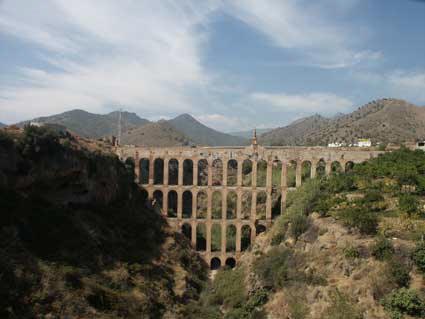
Between Nerja and Maro, the Acueducto del Águila — the Eagle Aqueduct — carries water across a valley on three tiers of brick arches, built in the nineteenth century to supply the sugar mills of the area. It is a striking sight from the road, and there is a lay-by where you can stop and photograph it.
The old sugar mill at Maro, the Ingenio, is now a small museum and cultural centre, and is worth a look on the way back.
Six kilometres inland and a world away from the beach, Frigiliana is one of the best-preserved white villages in Andalucía. Its stepped, cobbled alleys climb a hillside below the Sierra Almijara, hung with bougainvillea and geraniums, with the ruins of a Moorish castle at the top and views back down to the sea.
The village has a long craft tradition — ceramics, woven goods and pottery — and a good number of small restaurants and bars. It is famously pretty, which means it is busy in the middle of the day in summer; going early in the morning or in the evening makes a big difference.
It is about 15 minutes by car from the apartment. There are also buses from Nerja's bus station.
On Tuesday Nerja holds its weekly street market, where you can buy fruit and vegetables, clothes, shoes, bags and plenty of other bargains. Go early — by midday in summer it is hot and the best produce has gone.
Sunday brings an antique and craft market, including locally produced ceramics. It is a good place to pick up a proper souvenir of the Axarquía rather than something made elsewhere.
Market days and locations can shift with the season and with town works. Check locally when you arrive — the apartment folder has the current details.
This is the Axarquía, so the cooking is Andalusian and firmly seafood-led. Look for pescaíto frito — mixed fried fish, the local staple — along with grilled sardines cooked on skewers over an open fire on the beach, prawns from the bay, and boquerones in vinegar.
Inland, the dishes change: porra antequerana, game, goat, and the sweet Muscat wines of the Axarquía, grown on terraces in the hills behind the town. The local raisins and almonds are excellent, and worth taking home.
Nerja has a large number of restaurants, from simple tapas bars where you eat standing at the counter to smarter places on the seafront. The best value is usually a set lunch menu (menú del día), served in the early afternoon. Note that many kitchens close between about 4pm and 8pm, and that Spaniards eat late — a table at 10pm is entirely normal in summer.
The apartment is self-catering, and there are two large supermarkets within a five-minute walk. The Tuesday market is the best place for fruit and vegetables.
Nerja is unusually good for walking: a flat seafront in town, and serious mountain country immediately behind it.
The easiest walk in town, and the one you will do most often. Follow the coast from Playa de la Torrecilla east into the centre and on towards Burriana. Flat, paved and almost entirely car-free.
A river walk up a limestone gorge just east of the town centre. In summer the path becomes a paddle through shallow water between high rock walls, which is a wonderful way to spend a hot morning. Wear shoes you do not mind getting wet, and go with someone else.
Behind the town the mountains rise steeply. There are marked paths and forest tracks above Frigiliana and Acebuchal, with long views back down to the coast. Take water and start early — this is real mountain terrain.
Paths in the sierras are not all waymarked, and mobile coverage is patchy in the valleys. Ask locally before setting out, and let someone know your route.
Much more than an airport. Málaga has a Roman theatre, a Moorish fortress — the Alcazaba — up on the hill, a cathedral, and an extraordinary cluster of art museums including the Picasso Museum and the Pompidou's Spanish outpost. The old centre is a good day out, and about 40 minutes down the motorway.
The Alhambra is one of the great buildings of Europe, and Granada's Albaicín quarter is a maze of white alleys with the Sierra Nevada behind. It is a long day trip — about 1 hour 15 each way — and Alhambra tickets must be booked well in advance. Consider staying overnight.
The market town at the heart of the Axarquía, with a hilltop Moorish quarter and a busy market, plus the long resort beach at Torre del Mar just below it. An easy half-day out.
Competa, Canillas de Albaida, Archez, Salares and Sedella are all within an hour, each a cluster of white houses on a hillside surrounded by vineyards, olives and almonds. The drive alone is worth it.
Within Nerja, you will walk. The apartment is west of the centre, on the seafront, and everything in town — the Balcón, the shops, the restaurants, the market — is reachable on foot along the promenade. A car is genuinely optional for a beach holiday.
For the Caves, Maro, Frigiliana and the white villages, though, a car makes life much easier and gives you the freedom to stop at the viewpoints. Car hire is available at Málaga Airport and in Nerja itself.
Nerja's bus station has services to Málaga, Málaga Airport, Torrox, Vélez-Málaga and the villages inland, and there is a local bus along the coast. Taxis are readily available in the centre.
Nerja is a genuinely year-round destination. Sheltered by the Sierra Almijara, it has one of the mildest winters in mainland Spain.
If you have a choice, June and September are the pick of the year: the sea is warm, the town is not yet (or no longer) at full pitch, and the light is beautiful. Winter is the season for walkers and for anyone who wants Nerja to themselves — you will often be able to sit outside at lunchtime in January.
Figures are typical values for the Nerja area and are intended as a rough guide for planning, not a forecast.
There is no booking form and no agency in the middle — you deal with us directly. Tell us when you would like to come and we will confirm availability and explain how to secure your week.